

Buffalo Camp Part 2 ... (magabas and mores)

Updated: Sep 11

Days of rain, followed by more rain and what you get is luscious green growth, everywhere you look. The rain came and with it came the mud, then everything turned green. The magic of the proverbial just add water.
We had known the rains were coming, when they arrived, we had mixed feelings, the joy and relief from the endless days of heat, the smell of rain on dry dust is one of my oldest memories and one of the most difficult to describe. A surrender of dust to water, a dry wetness where the two elements of dry earth and rain drops meet, for a brief moment there is that transience and with it that smell, so distinctive, so of the moment, it hangs in the air like an alchemist's secret. Then there is mud.
Where there is no grass there is mud and at Buffalo Camp, there isn't much grass, well not of the lawn variety. We do have a roof, as the clouds gathered we pressed on with that plan and we got there before the season started. It's a thatched roof, the traditional roof of Africa. Cool in summer, warm in winter, and dry when it rains.


Well, in theory anyway, the thatchers who made our roof were long gone by the time the rains fell upon their work and it turned out that there were leaks. Not many and not always in the same place. In Zimbabwe, the weather report has always had the same cliched terminology, there are always "scattered showers" expected in the rainy season, or "intermittent rains". We have scattered, intermittent leaks in our thatched roof. When I shared this information with the thatcher, Shedmore, he suggested I put another cement ridge over the one he had done and sent me a nice photo of his latest project in some far flung corner of Zimbabwe. The message was you are on your own, no warranty.


And so began our on-going experience with what came to be known as the "magaba job". The name of Shedmore's assistant, with whom he had spent 2 weeks living in our tent while they built our thatched roof, was Lovemore. After they had departed but before it started raining, Grainmore arrived to do some brickwork walls and to build our septic tank. The romantic notions of an organic toilet had faded over time and the prospect of an open-air bathroom during the rainy season had lead us to the conclusion that we could now evolve to the water closet and an even later innovation, the septic tank.
First, we had to agree on a price for Grainmore's skills as a brick layer and experienced septic tank engineer. He opened the bidding at $ 400 for the septic tank. When I googled how many bricks an average brick layer could lay and divided that into the number of bricks expected to be in our septic tank, I discovered that $ 400 was, as I had already suspected, an exorbitant price. I told Grainmore and he immediately asked what about $ 200? At this point he added that it would not be a magaba job. To me magaba sounded like MacGyver, in which case I was thinking, if it was a MacGyver job that would be a positive and promising me the opposite was hardly going to convince me. He followed up his argument with the fact that he had built a septic tank for another musungu in the neighbourhood for $ 400, but for me he would only charge $ 200. Some days later when I was giving Grainmore a lift to the main road, he was to point out the property where he had built this septic tank, it turned out to be much larger project than ours. A facility for 12 people while ours was for half that number and half the size.


Anyway, I liked Grainmore he was a cheerful fellow and I agreed to the $ 200. By my reckoning and from what he had said about the number of bricks he could lay, he would take two days to build the septic tank and then we would move on to the next job of building the bathroom and loo. As a general labourer and assistant I enlisted Trymore, a young man living nearby. Trymore would also help me collect bricks from the the main road where Mr Gudo sold bricks and building sand. Mr Gudo literally translated is Mr Baboon, I have not asked Mr Gudo what his first name might be. As Mr Gudo ran a thriving and organised business, I guessed there was less possibility that his name ended in " more ".
By that afternoon Grainmore had finished the brick work for the tank, he left saying he would be back tomorrow. The next day he didn’t show up, then the following day he arrived back on site, accompanied by his wife and a baby. His wife had wanted to come to work with him to make sure he was actually working. That was my evaluation of the situation, although this was never explained to me. I informed Grainmore that perhaps the next day he could ask his wife to stay at home, he said that would be no problem and had I noticed that he wasn’t doing a magaba job? He burst into laughter and I joined him. Over the next few days the word magaba came up frequently and we laughed a lot, about this job not being a magaba job. I wasn't sure if I should be laughing as much, but it's always the easiest option, in Africa. I might add that John Cleese and the Pythons have always been some of my favourite comedy. Sometimes life seems to be running in a similar vien here in Africa. It is possible that's only my own personal twist on what we call reality but it gets me through the day.

By now I knew the word wasn’t MacGyver and obviously a magaba job was not a good one, ironically Graimore seemed to be contradicting himself, which was kind of funny. He was doing a magaba job even if he said he wasn’t and he seemed convinced that he wasn’t doing a magaba job. The power of repetition, of a double negative, was working on me. He was laying bricks but not in quite the same skilled manner I had seen from other brick layers at work. In a moment of clarity, I pointed this out, amongst other shortcomings, such as splattered mortar on just about everything. He told me not to worry, when he had done the plastering, everything would be fine. Depending on your intial expectations, I suppose you could say it was.

As the work on the bathroom progressed we needed more bricks from Mr Gudo, this involved driving down the the petrol station on the main road where Mr Gudo had his office and his building materials, literally on the side of the road. Bricks and sand. At the garage my name is Mr Benjamin, because I often produce a 100 dollar bill to buy fuel and get change in smaller notes. Elsewhere you might do this at a bank but in Zimbabwe all the cash is at the petrol stations - the petro dollar. The economy runs entirely in US dollars, as I have explained earlier in our story. On the 100 dollar bill is the face of Benjamin Franklin. Hence the $100 note is known as a Benjamin. On this occasion I had a large number of Benjamins in an envelope in the cubby hole of my car, as I was about to pay the school fees, I had counted them that morning. I removed one from the envelope to pay Mr Gudo, unaware that Trymore had observed me doing so. The cubby hole is not an obvious compartment and looks like part of the dashboard, until you see it opens you wouldn’t know it was there. Later that evening as I thought through the events of the day it dawned on me that what I had done at the petrol station was not very clever. I knew the exact number of Benjamins that were in the envelope, so I took it out and counted them. There was one Benjamin short, I counted them again, there was still one Benjamin short. The next day I told Trymore that I could no longer offer him a job because someone had stolen the money with which I had intended to pay him. Grainmore lost his assistant, given the unfortunate circumstances, he understood that it was better to continue without a thief in our midst. I was 99% sure who had taken the missing Benjamin, on a positive note ( no pun intended) he could have taken them all! So Trymore got paid early. I had to accept that I had been foolish and sent myself a memo on the subject. It was'nt the first time and it won't be the last.
By now it had started to rain in earnest and we realised that the thatching was a magaba job. Our expectations were on the decline as we moved on to throwing the slab for the floor. We explained to Grainmore that we wanted the floor to be flat and level and we didnt want it to be a magaba job. More laughter, of course, there would be no problem with that and somehow, we had a feeling that this again, was going to be a matter of opinion. Sure enough the slab was a partial success. While it was level in some places when we poured water on it, as Grainmore had suggested the day after he had left to visit a sick friend in the homelands, we discovered areas where pools formed and others where the surface was not smooth at all. It was a magaba job.
We decided we had had enough of the " mores ". In Zimbabwe a large portion of the population has english names like Faith, Hope, Charity, Beauty and Loveness these names are all quite common. Then another trend has led to names ending in “more". As one meets more and more people this becomes apparent, in ever surprising variations. Apart from the “mores" above I have met Givemore, Winmore,Takemore, Learnmore and even Oncemore. We were determined to put a screed on our floor and this time we would get it right and it wasn’t going to be with Grainmore, or any other "more", who delivered less.
We reached out to a friend in the building industry who knew someone who did slabs and screeds and we were encouraged when he turned out to be called Phil. Our thinking was to try a different approach for a different result. Phil and his colleague came and looked at Grainmore's efforts and said they could do a screed over it all and it would work out fine. We told them about the magaba job joke, because by now I had resorted to my long-standing maxim of how to deal with life in Africa (- either laugh or cry). They explained the origins of the word magaba. It is a district in downtown Harare where you can buy brand names of various goods that are often imitations of the real thing and very soon after purchase they fail. Hence the saying something is (or isn’t) magaba.
The following day Phil and his friend set to work on the screed, we were adding a slight complication by wanting to colour the screed to a yellowish hue, as opposed to cement grey, by adding yellow oxide. This process can weaken the final screed if too much oxide is added, so we took some time to get this right, and the job ran on until after dark. The screeds were done in three sections and the next morning when we added water to cure them, we discovered that while we now had variations of more or less magaba, we still had a magaba job!
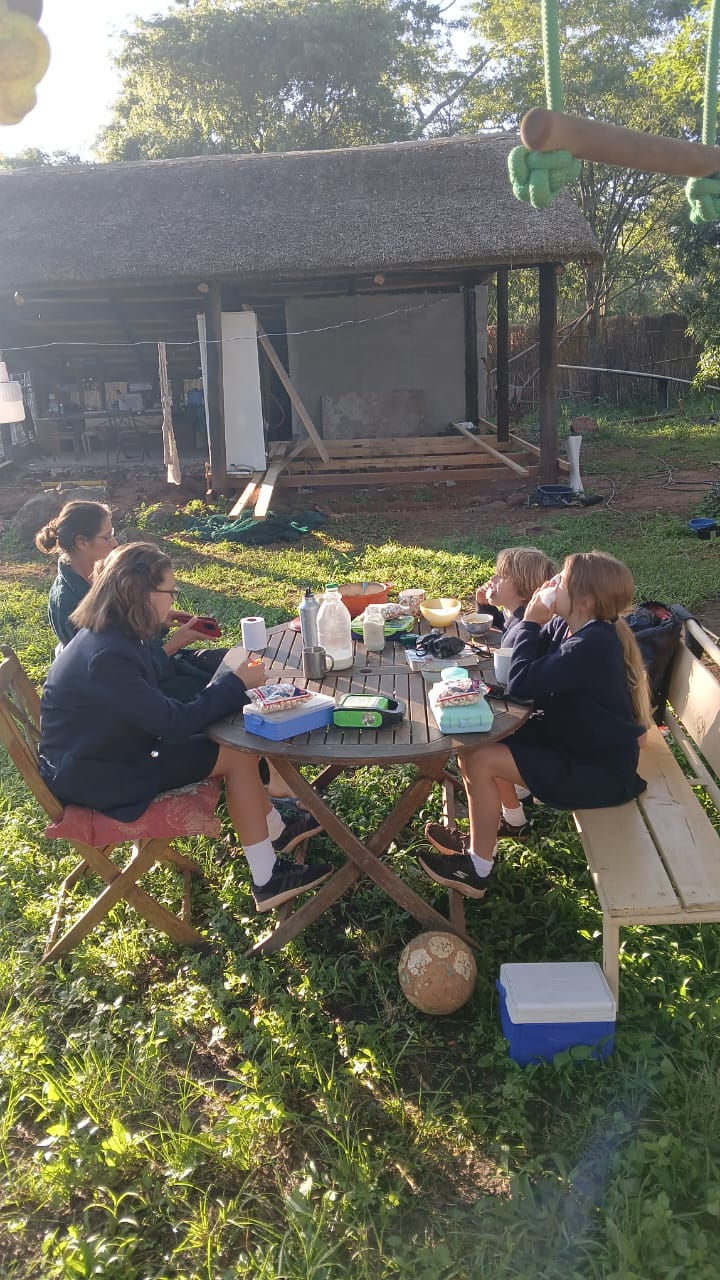
This finally brings me to a realisation, if not to an epiphany. If we are going to rely on others to do the work and come out with a result that I could have possibly achieved myself, while learning a new skill, I may as well give it a go. Learn something new and save some money. As my mother often said, if you want something done properly you may as well do it yourself. It is not really the fact that you may be better at it than someone else, but you probably care more about the end result. Brick laying was probably a bridge too far for me, but what about carpentry? The next floor that is needed is a wooden one for the bedrooms and we are done with looking for any help. I am going to do the floor myself. If it turns out to be a magaba job, it will have cost us less than any of the other magaba jobs.
On the other hand, it might be better and I will have learnt something about wooden floors. If I get enough practice, there are going to be some walls needed too. You know what, confidence may not be everything, but I am saying - it’s not going to be a magaba job!


Comments